
Current Issue Highlights
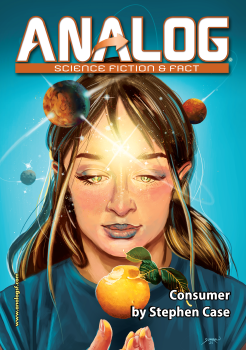
March/April 2026
At the risk of being vague for fear of giving anything away, our cover story for this issue, “Consumer,” is a blend of hard SF and grand space opera from Stephen Case that you don’t want to miss!
Our fact article, Michael W. Carroll’s “Homes Away from Home,” examines the practicalities of settling and permanently residing on (and in) the Moon.
We also have a thematically complementary Special Feature in “Seeds of Cities,” from M.C. Childs, on the design and planning of future cities (including thoughts on the matter from some SF luminaries, just for this article).
And of course there are plenty of other pieces where those came from: it turns out that big rig trucking has more applications than one might expect in “Rovers,” from Paul Carlson; enclosed living begins to have a deleterious effect on an artist in MB Valente’s “False Light”; the opportunity to explore distant worlds in alien bodies proves both more and less than envisioned, in “To Wear a Golden Sorrow,” by Eric Del Carlo; the last (?) remaining human in a future of ascendant AI bristles, in Tom R. Pike’s “Conscience”; a particularly drastic emergency maneuver in orbit, in “Slingshot” from David Gerrold; and more, from HAB Wilt, Gregor Hartmann, Jay Werkheiser, and others.
You don’t want to miss it!
NOVELETTE
False Light
by MB Valente
The psychiatrist’s face was a distant gray blob, his voice muffled. Wey blinked and shook her head. She leaned across the transparent floating coffee table and said, “What?”
“I said that sounds worrisome.”
Wey nodded and looked at the window. It was a wheat field ruffled by wind, slurry green mountains sandwiched between the rippling gold and an aggressively blue sky. On the far side of the table, the blob that was Dr. Kulver was listing off nonsense words, possibly the names of medications.
“Oh yes, all that,” Wey said.
“Well, I think it’s too much.”
There was something disturbing about the window. Something experimental—it reeked of clinical trials. READ MORE
Consumer
by Stephen Case
Thoughts in space came slowly. Trennis knew this was true, but she could not feel the difference. Her mind was spread across the radius of her drone swarm so that thoughts that would have lanced through physical neurons in milliseconds took orders of magnitude longer, skipping through drones separated by entire light seconds. Instead of feeling her thoughts slowed though, it felt rather that the universe had sped up around her. She could almost see the whorls of nebula drifting in gentle spirals through her sensors. READ MORE
POETRY
Sour Grapes
by Holly Day
DEPARTMENTS
Guest Editorial: Artificial Stupidity
by Stanley Schmidt
One of the email services I use has recently taken to prefacing each of my incoming messages with an “AI overview.” One of these emails was from a fellow player in a concert band who also plays in some other groups. He had warned me that he would have to miss one of our rehearsals because one of his other groups had a conflicting rehearsal that he had to give a higher priority. A bit later, his conflicting rehearsal was canceled, so he emailed me that he would be at our rehearsal after all. READ MORE
Alternate View: “Mitochondrial Doping” is Coming to Sports
by John G. Cramer
Competitive sports are already grappling with complex “doping” problems. If generic mitochondrial transplantation (see AV 233 in the Nov/Dec 2024 Analog) soon becomes a standard treatment widely used in hospital emergency rooms, its spillover effects in competitive sports may be far-reaching and profound. It will probably impact everything from levels of athletic performance to anti-doping regulations and detection methods. It may perturb the essential definition of just what “natural” athletic ability is. READ MORE
Reference Library
by Rosemary Claire Smith
This being my tenth stint at reviewing books for Analog, I find myself wondering about the wisdom of evaluating books representing the midpoint of a series, or even the final work. I’ve done so several times. If I did not, I fear readers might be deprived of the opportunity to read some wondrous novels for years, or miss out entirely if the works become unavailable. That said, I nevertheless question the wisdom of reviewing mid-series books. Those who have read the previous ones are likely to have formed firm opinions as to whether they wish to press on to the next one. Those who decide to bail out mid-series certainly have their reasons. Sadly, one reason is the well-founded frustration that a series may never wrap up. Sometimes the writer doesn’t finish it. Sometimes the publisher doesn’t think it financially advisable to publish more books when the first one or two rack up disappointing sales figures. Dear readers, this is where you ride to the rescue. Yes, you! If you enjoyed the author’s previous works, please please buy the first and second ones in their new series. Doing so makes it more likely that more will be forthcoming. If these turn out not to be to your taste, nothing forces you to slog through to the bitter end. The writer won’t even know. Besides, books are not like the food on your plate that a parent insisted you finish. READ MORE